The Conservatives managed a landslide in the general election in the UK on 12th December 2019 by obtaining 365 seats –more than an absolute majority- and inflicting a crushing defeat on the Labour Party –that got only 203 seats. The Scottish Nationalists got 48 seats (13 more than in 2017), the Liberal Democrats obtained 11 seats, with the smaller parties receiving the reminder 23 seats. The electoral outcome was so devastating that the Conservatives have an absolute majority even if all the other parties in Westminster were to vote together against them, they would still be short by 80 votes.
Johnson’s majority is smaller than Thatcher’s in 1983, when the Conservatives got 397 seats, an absolute majority of 144 seats against all other parties combined together; and still smaller than Thatcher’s victory in 1987 with 376 seats (102 seats more than all other parties combined). Thus when contextualised over a larger time span, Johnson’s victory does not look as formidable.
The result came as shocking surprise, especially considering that Labour’s politics were dominated by the phenomenon of Jeremy Corbyn, whose popularity among Labour supporters was very high. It led to a substantial strengthening of the party whose membership high-rocketed to over 800,000 but eventually settled around 480,000 (the largest social democratic party in Europe (the German SPD has 426,000), and almost as large as the combined membership of all the other British political parties (Conservatives – 180,000 -, Scottish Nationalists – 125,534-, Liberal Democrats – 115,000 –, Greens, – 48,500 – UKIP –29,000 –, and Welsh Nationalists – 10,000 –, who, together come to slightly over 500,000). Data from UK Parlament.
Furthermore, most British trade unions are formally affiliated to the Labour Party, and most of them, with some substantial differences on some issues –notably the replacement of Trident – were politically aligned with Jeremy Corbyn, who they have supported solidly since his election as Labour leader in September 2015 at every national conference, defeating attempts by Labour’s Blairite right wing to replace him.
The election results mean that when compared to the 2017 general election, the Tories got 48 extra seats, whilst Labour had a massive loss of 24. However, up to the 2019 election, Labour’s vote was going up, whilst that of the Tories was gong down:

As it can bee seen from the Table 1 above, between 2015 and 2017 Labour was on what seemed a solid recovery by an increase of 30 MPs and 3 million more votes. Labour under Corbyn’s leadership had to wage an electoral campaign not only virtually against all other parties, but also against its own right wing that, commanded by Peter Mandelson, (with Blair pulling the strings from behind) dedicated itself to systematically sabotage and demonize its own party, even to the point of some of its representatives openly calling to vote against their own party. An aggressive campaign of demonization by the corporate media conducted an insidious and discredit sturdily supplemented this.
Under Corbyn Labour’s vote increased by 2,5 million in 2017, denying the Tories a parliamentary majority thus leading the government to bribe the Northern Irish right wing Democratic Unionist Party by increasing spending in that region by £1bn, which secured Theresa May a majority.
The Establishment deemed the intense media hostility both against Corbyn and his radical policies, insufficient, and therefore, it mobilised NGOs, intellectuals, academics, artists and everything else they could among respectable society. At the time, polls gave Labour 32% (May 2015) and 25% in (March 2017). Throughout that period the media and spokespersons of this broad right wing anti-Corbyn coalition, pumped the message that Corbyn was unelectable, aimed at forcing his resignation from Labour’s leadership. Faced with such hostility, it was amazing that Labour increased its vote getting 30 more MPs.
Additionally, Theresa May’s Conservative government was saddled with the issue of Brexit, since it had to confront persistent parliamentary back stabbing from the anti-European wing of her party, especially from Boris Johnson. May lost several parliamentary votes when trying to legislate the implementation of Brexit.
All of this was taking place against the background of the 2016 referendum on the UK’s European Union membership whose result shook all parties, particularly the Conservatives, to their foundations when it was learned that nearly 52% (17,410,742 votes) voted to leave with those in favour of staying obtaining 48% (16,141,241 votes) that is. The turnout was 72%, higher than normal.
With the exception of UKIP, most parties formally campaigned to stay, including the Conservative PM, Theresa May, but also Labour under Corbyn, the Liberal Democrats, the Scottish and Welsh Nationalists, and Greens. Both major parties, Labour and Conservatives, contained active minorities who vigorously championed Brexit. They were substantially stronger among Conservatives, were even ministers resigned in protest against the pro Remain position of Theresa May. They deployed the infamous NHS Bus falsely publicising that upon abandoning the EU Britain’s public health service would receive £350 million per week, amount they argued, Britain was sending in various payments to the EU. FullFact, a fact-checking charity, demonstrated the claim to be false and wrote
Mr Johnson’s most recent claim in the Telegraph is still inaccurate, despite his more careful wording: it doesn’t make sense to talk about taking back control over money that is never sent and never owed to anyone else.
Johnson is not only a ruthless operator but also quite an unscrupulous politician. Throughout the Corbyn years, he would make outrageously inappropriate and unacceptable statements on race, women, the poor, the environment, and so forth and, therefore, was depicted as an insensitive upper-class clown. Johnson’s media appearances in TV interviews projected him as a mumbling trickster who would garble his way out of tough questions, or would just simply utter straight lies. What helped Johnson to get away with such crude lies was the overall gentility deployed by the media, that either engaged in amazing acrobatics or simply suppressed information about it, in sharp contrast with the antagonistic treatment meted out to Jeremy Corbyn and his policies.
This low-level intellectual quality and political shambles has characterised the leadership of the Conservative Party ever since John Major’s Premiership (1992-1997), who sought to salvage the nation from Thatcher’s wreckage by abolishing some of her worst and most unpopular policies such as the Poll Tax. Since then, the low intellectual, level, lack of a UK economic strategy, has characterised this emerging, ever more dominant, extreme right wing leadership, whose politics oozes racism, misogyny, and bigotry.
The Conservative politicians who today dominate the party, individuals such as Boris Johnson, Michael Gove, Jacob Ress-Mogg, Liam Fox, and the like, are extreme pro-market libertarians, anti-statist, deeply opposed to the welfare state – which they seek to dismantle –, and almost irrationally anti EU. Some of them champion extreme ‘Christian’ values on sexual diversity, same-sex marriage and, of course, abortion. Their views have a strong resonance in the party since its membership is 71% male and 97% white (Anna Soubry, “The hard right has captured my old party – and Boris Johnson’s victory proves it“, The Guardian, 23rd July 2019 (Soubry was Tory MP for Broxtowe in Nottinghamshire). Pretty much gone are the ‘one-nation’ Tories, who, broadly speaking, are pro Europe, favour industrial development instead of finance capital, believed in maintaining the bulk of the welfare state, and are modern on abortion, sexual orientation, race, and so forth..
Tough, as can be gauged from the statistics discussed above, it has always been difficult for Labour to defeat the Tories’ formidable politico-electoral machinery, nevertheless under Corbyn’s leadership Labour had developed not only a radical government programme of substantial structural anti-neoliberal reforms, but one that, as testified by many polls, hugely resonates with the electorate with some policies polling well above 70%. Thus in the 2017 manifesto 79% supported that electricity and energy came from low-carbon or renewable sources, 74% were in favour of capping rent prices at the rate of inflation, 68% were in favour of increasing income tax for top 5% of earners, 63% agreed with requiring business to reserve a proportion of seats on their boards for their workers, 60% supported railways to be owned and run by the state, 57% agree with the utilities industries like energy and water companies being owned by the state, 55% supported free university tuition fees for all students, and 52% were against the UK taking part in military interventions in other countries.
Corbyn added that all expansion of the health service that had taken place under Tony Blair, which allowed the private sector to run growing sections of the NHS, including full newly-built hospitals, would all, 100%, be fully nationalised, a policy that elicited enthusiastic support in British society as a whole, especially because Tory austerity had so underfunded the NHS to the point of creating a massive crisis in health provision well captured in video Corbyn issued:
In the face of all the evidence – patients being treated in hospital corridors, people dying in the back of ambulances, hospitals in dire need of repair- they are refusing to give our NHS the money it needs and needs now. The NHS will only survive if we fight for it. (See details of the Tory, austerity-driven, crisis generated in the NHS in Steven Hopkins, “NHS March In London Sees Jeremy Corbyn Blame ‘Tories And Austerity For Crisis’”, The Huffington Post, 3, February 2018).
In fact, the impact of Corbyn’s 2017 manifesto was such that Bloomberg commented Corbyn’s Labour Party will offer voters one of the most radical economic agendas anywhere in the democratic world. (Matthew Goodwin, “‘Corbynomics’ Is More Popular Than You Think”, Bloomberg, 2nd October 2019). Another Bloomberg piece reported with alarm that not only Labour 2017 was endorsed but much more was added to this agenda at the September 2019 Labour conference held in Brighton:
The integration of private schools into the state system;
A Green New Deal that sets a target of 2030 for net zero carbon emissions. (A Labour government would nationalize the country’s big energy firms, ban fracking, and take public transport into state ownership);
The restoration of full trade union rights and workplace rights, rolling out collective wage bargaining;
A 10 pound ($12.36) hourly minimum wage;
A 50,000 pound lump-sum payment to veterans of British nuclear tests for help with medical problems;
A scrappage scheme for polluting vehicles and 2.5 million interest free loans for the purchase of electronic vehicles. The construction, with private investors, of three large battery gigafactories. (Therese Raphael, “Jeremy Corbyn Is Planning a Revolution”, Bloomberg, 27 September 2019)
The titles of the two Bloomberg pieces are telling: ‘Corbynomics’ Is More Popular Than You Think and, Jeremy Corbyn Is Planning a Revolution.
At media and parliamentary debates Corbyn’s performances against May and then Johnson were impressive primarily because he denounced the government austerity policies’ consequences on people, society and economy. Furthermore, he toured the nation delivering rabble-rousing speeches about his progressive vision for the UK. A nationwide, strong grassroots developed and grew out of this. Johnson, on his part, monothematically stressed the need to ‘get Brexit done’. By the end of November, Johnson was actively shunning TV appearances, interviews and debates, and was reported in some of the media as “avoiding scrutiny”.
PoliticsHome revealed the mixed public sentiment by reporting on snap poll taken after the 6th December 2019 TV debate: Corbyn had a 10 point lead on who came across as more trustworthy, and on the NHS, he won 55% to 38%, whilst Johnson won 62% to 29% on who performed best during the section of the debate around Brexit. In other words, if the election were fought on Brexit, the Tories would have the edge, but if the focus was the NHS, austerity and the gross inequalities it had generated, then Labour was likely to carry the day.
Thus the Establishment and the Tories deployed all its resources to exert pressure on Labour aimed at making Brexit the crucial issue of the coming election. The pressure was such that it affected even Corbyn’s inner circle. This served the double purpose: it distracted from Labour radical manifesto and exacerbated Labour’s internal divisions. Furthermore, by Labour adopting a pro Remain position, after the 2016 referendum, depicted Labour as disrespecting the democratic decision of the British people. The Tories’ calculation turned out to be correct: making Brexit the central election issue would give them a crucial edge. The crucial lever of the Establishment to pressurise Corbyn were Labour MPs who were overwhelmingly anti Corbyn.
From the moment Corbyn had been elected Labour MPs had sought to oust him, even going for a parliamentary coup by passing a no confidence resolution against the Labour leader in 2016, which involved even Labour’s Deputy Leader, Tom Watson. The coup involved mass resignations by Labour right-wingers from the broad-based Shadow Cabinet that Corbyn had established to include all shades of opinions in the party. They blamed Corbyn for the Brexit vote. Media reports at the time suggested that about 80% of the Labour MPs were in the plot. In fact, 172 MPs voted for a no-confidence motion against Corbyn, whilst only 40 supported him. This not only triggered a leadership election with Labour’s right seeking to prevent Corbyn from being on the ballot by an unsuccessful High Court action. The ensuing leadership election saw a Corbyn victory with a larger majority.
This breed of Labour MPs was the result of 10 years of Blair leadership who not only shifted Labour drastically to the right (and to the extreme right on international issues as witnessed by the Iraq War) but who also to implemented severe attacks on the party’s internal democracy, which included favouring Labour candidates of a right wing, Blairite, persuasion. Corbyn, therefore, had to contend with this specific aspect of “Blair’s legacy.” A poignant manifestation of this ‘legacy’ was the attitude adopted by the majority Labour parliamentary party on the renewal of the Trident submarine nuclear military system. Labour’s formal position was in support but Corbyn sought a compromise of retaining submarines but without nuclear weapons. The outcome was 140 Labour MPs voted with the Conservative government to renew Trident, 47 joined Corbyn voting against, while 43 abstained. Thus, though it was clear that Corbyn’s leadership was unassailable, the bourgeoisie, the Conservatives and the Establishment had in Labour’s MPs a formidable ally.
This pressure did not confine to statements alone but also led 8 right wing Labour MPS, headed by Black MP, Chuka Umunna, to even break with the party, thus deliberately jeopardising Labour’s electoral chances. The bases of their defection was Corbyn’s supposed inability to stop Brexit and, for good measure, they threw in the well publicised media-led campaign of Labour being anti-Semitic with Corbyn being unable or unwilling to tackle it. When the ‘rebels’ announced more mass defections to follow, this right wing pressure did the trick.
Right wing Labour MPs were also able to mobilise progressive individuals in the parliamentary party, the unions, and among the Labour membership, especially in the South East, to campaign for Labour to go for a second referendum. They eventually managed to saddle Corbyn with such a policy. Thus Corbyn went into the 2019 election with the formal position of a second referendum, which would ask the electorate whether to accept or reject the first referendum. Thus Corbyn, instead of focusing on the Brexit specifics proposed by the Conservative, he caved in and announced:
This will be a trade deal with Europe or remaining in the EU – that will be the choice that will be put before the British people within 6 months. Any other option will require years of negotiations either with the EU or the USA.
Then, he added, “I will adopt, if I am Prime Minister at the time, a neutral stance so I can credibly carry out the result of that to bring our communities and country together rather than continuing endless debate about the EU and Brexit.” This happened on the Question Time national TV programme on 22nd November 2019, that is, days before the general election. The Tories, Johnson and the media quickly capitalised on it. With this statement, Corbyn unwittingly, made Brexit the central issue of the coming election. Thus paradoxically, in order to unite the party, he ended up alienating a crucial part of his electoral base. The media went into full anti-Corbyn gear.
Since his surprising election in 2016, Corbyn faced a relentless, vicious and unscrupulous media campaign against him and his project. Anti-Corbyn media bias was such that led scholars in the LSE to conduct a study, which concluded
“… Jeremy Corbyn was represented unfairly by the British press through a process of vilification that went well beyond the normal limits of fair debate and disagreement in a democracy. Corbyn was often denied his own voice in the reporting on him and sources that were anti-Corbyn tended to outweigh those that support him and his positions. He was also systematically treated with scorn and ridicule in both the broadsheet and tabloid press in a way that no other political leader is or has been. Even more problematic, the British press has repeatedly associated Corbyn with terrorism and positioned him as a friend of the enemies of the UK. The result has been a failure to give the newspaper reading public a fair opportunity to form their own judgements about the leader of the country’s main opposition.”
Prize winner, journalist Jonathan Cook, highlighted the specific role of the BBC in this bias by looking at the work of the Media Reform Coalition and Birbeck, University of London, whose study argued that “imbalanced reporting” has become so grave that it poses a serious threat to the democratic process.” Their study reveals that
“…the BBC is failing to make even the most minimal efforts at even-handedness. The issues it uses to frame its news coverage are nearly five times more likely to present Corbyn in a negative light. Even worse, BBC news headlines during the study period failed to frame any story in a positive light for Corbyn.”
Remember that the BBC, unlike the press, is supposed to abide by strict rules of impartiality, and that its early evening news programme is probably the single most influential source of news for most Britons.”
Media bias against Corbyn never stop and was relentless even to election’s eve, when the charge of Labour being anti-Semitic was raised at the last minute by none other than the Bishop of Canterbury, UK’s maximum religious authority, who on 26th November 2019, publicly endorsed and supported UK’s Chief Rabbi, Ephraim Mirvis, who had said that Jews were “gripped with anxiety” at the prospect of Corbyn becoming Prime Minister. The Bishop, Justin Welby, said that Mirvis’ warning should ‘alert us to the deep sense of insecurity and fear felt by many British Jews’. The charges that under Corbyn anti-Semitism had flourished had by then at least 2 years of longevity.
The Media Reform Group also conducted a study on how anti-Semitism was also used by the media to demonise Corbyn and the Labour programme associated with him. Their report, Labour, Antisemitism and the News. A disinformation paradigm, states
“The Media Reform Coalition has conducted in-depth research on the controversy surrounding antisemitism in the Labour Party, focusing on media coverage of the crisis during the summer of 2018. Following extensive case study research, we identified myriad inaccuracies and distortions in online and television news including marked skews in sourcing, omission of essential context or right of reply, misquotation, and false assertions made either by journalists themselves or sources whose contentious claims were neither challenged nor countered. Overall, our findings were consistent with a disinformation paradigm.”
As it happened, in the 2019 election the Conservatives won 54 seats from Labour, but overall, Labour lost 60. It is very telling that only 8 out of those 60 constituencies had voted Remain, whilst the reminder 52 had voted Brexit in the 2016 referendum, with percentages going from 50.1% (Colne Valley) to 72.1% (Stoke-on-Trent North). Labour lost seats that it had held since 1919, 1922, 1932, 1935, 1945 and 1970, so it would be wrong to draw the conclusion that all of the sudden, the working class bastions of Labour had converted to the brand of Conservatism espoused by Boris Johnson. The only explanation is that a substantial proportion of people in these bastions favoured Brexit and found Labour’s position of another referendum unacceptable since their vote for the first might be worthless.
Poverty, destitution, unemployment, homelessness and other social ills in these Labour heartlands for many were closely associated to the policy of open immigration resulting from Britain’s membership of the European Union. This has been the persistent message to the nation from Conservative leaders, whether in or out of office, since Thatcher: unless immigration is severely curved, the UK and its citizens would continue to suffer these ills and in the last years they have made strenuous efforts to link immigration to terrorism. And, there is no doubt that the pro Brexit referendum campaign intensified racism, bigotry and xenophobia to high levels: according to official figures, recorded hate crime rose sharply by 57% between 2014-15 and 2016-17, with 87% motivated by racial hatred.
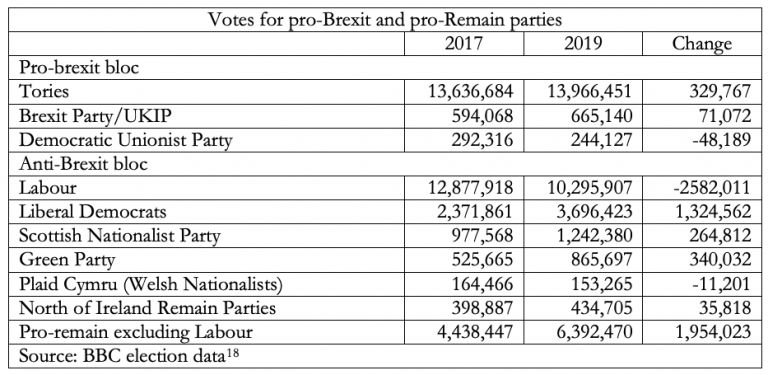
Additionally, as can be seen from the table below, Labour lost 2 million votes to pro-remain parties (Liberal Democrats, Scottish and Welsh Nationalists, Greens, and pro-remain in the North of Ireland):
So, what now? Which way forward for the Labour movement in the UK after the crashing defeat of Corbyn, the most radical and most progressive political leadership to emerge in the UK and Europe? Corbynism was political phenomenon that developed and was equipped with the formidable political armoury against neoliberalism, inequality, lack of opportunity, racism, xenophobia and war. Is it all over for Corbyn’s manifesto?
Conclusion
As part of the necessary process of reflection to explain and absorb the lessons emanating from the election defeat, two schools of thought are emerging: on the one hand, the broad anti-Corbyn front that goes from openly fascist currents, the Establishment, the Tories, UKIP, Liberal Democrats, Scottish Nationalists, most of the corporate media, Labour’s right wing and even sections of the so-called Labour left moderates, and on the other, the vigorous social and political movement labelled Corbynism which includes Labour’s rank & file, most of the trade unions and the working class it organises, women, the poor and the marginalised, pensioners, the disabled, ethnic communities, the LGBT community, and all those who were included in Corbyn’s oft-repeated message “for the many, not the few”.
Their concrete interests and aspirations were incorporated in Corbyn’s radical manifesto, a vision of a better country so as to build a better world for them, for their children and for their children’s children, programme that clearly enjoys majority support in society. It is this that the reactionary anti-Corbyn front wishes to destroy. Within Labour’s Right, the key individual is Tony Blair, who has vigorously campaigned against Corbyn and his politics ever since the latter’s election to the party’s leadership in 2016. Blair did this at every election and also in 2019 and at a well-publicised statement hosted by Reuters where, though he criticised the Tories, he said “the Labour party has been taken over by left wing populism”, thus deliberately undermining the party’s leadership and its electoral chances.
No sooner had the elections results been known that media pundits, relishing in his defeat, built up pressure for Jeremy Corbyn to resign. One of the first to hit the waves unsurprisingly was Tony Blair who made an impassionate appeal to Labour to drastically change course and abandon its radical left wing ideology, and take the party to the “centre”. Blair was clear that the central issue is not Brexit but the fact that “The far left that has taken over the Labour party [and] If they’re in charge of the Labour party going forward, then I think the Labour party is finished.” Though he avoided attacking Corbyn personally, Blair savaged Corbynism:
“…politically people saw him as fundamentally opposing what Britain and Western countries stand for, he personified politically an idea, a brand of quasi revolutionary socialism, mixing far-left economic policy with deep hostility to Western foreign policy which never has appealed traditional Labour voters, never will appeal to them and represented for them a combination of misguided ideology and terminal ineptitude that they found insulting.”
This was immediately supported by a declaration of war against Corbyn’s Labour from Blair’s Press Secretary, Alastair Campbell, the media mastermind of the strategy behind legitimising the war against Iraq, fired from the hip by declaring war on Corbynism, calling on disgruntled and disillusioned Labour supporters to re-join the party to drive out “the left wing factions” that currently had the party’s leadership. In this connection, the Express’s headline is indeed eloquent of what this means: Labour civil war: Campbell leads charge of 100,000 moderates in bid to crush Team Corbyn.
On the other hand, there is the overwhelming majority of the membership, even many of those who may have voted for Brexit, who are unlikely to support a shift to the right by Labour as advocated by Blair et al. The shadow Business Secretary and MP, 40 year-old Rebecca Long-Bailey, a strong and loyal Corbynista, is being tipped as a potential successor to Jeremy Corbyn. She, or any other left wing Labour candidate for the leadership, have the enormous advantage of the powerful grassroots progressive and radical movement Jeremy Corbyn created during his leadership.
This movement can gather strength from the substantial popularity of the policies contained in Labour’s Manifesto. In this regard, the stance the trade unions, especially UNITE (the largest and most left wing union in the UK), take with regards to who to support to succeed Corbyn. Though it is too premature to say too much about the next Labour leadership, there are two certainties: Labour’s grassroots will not support a Blairite to replace Jeremy and they will resist shifting the party to the right. Perhaps, the biggest threat may come from a soft-left candidate behind whom Labour’s right will unite.
Labour’s right key argument to shift the party to the “centre’ is predicated on the fallacious argument of the lack of “electability” of Corbyn type of policies. The fact that in the 2015, 2017 and 2019 elections, the Liberal Democrats, the “centrist” party par excellence, performed very poorly, confirms this fallacy. A positive sign that Labour can resist Blair’s push to the right is the fact that of the 25 newly elected Labour MPs, 20 are women, 16 are solidly left wing, and 12 are BAME (Black, Asian and Minority Ethnic Labour), showing that despite the electoral defeat, Labour’s left has been strengthened at the level of the parliamentarians, thus weakening Labour’s right. Furthermore, “Labour now has a majority female parliamentary party.”
The battle lines have been drawn and the defence of Corbyn’s legacy is not just a matter of romantic adherence to purist or radical principles, though principles are certainly involved, his policies will be the essential platform from which to organise the resistance against Johnson’s nasty and ominous neoliberal offensive. Shifting the party to the right will substantially contribute to make its implementation easier. Johnson’s pronouncements to unite the nation and move forward, giving reassurances about economic regeneration and more funding for social services and the NHS are just fakery. He is representative a new breed of hard-right Conservative MPs that have much more in common with Donald Trump than with Thatcher thus, we must expect the worst.
A special report (by The Guardian’s ‘Long Read’) shows the long-standing and strong connection between key ministers and Conservative politicians, including Johnson himself, and extreme US right wing thinktanks such as the Institute of Economic Affairs and the Heritage Foundation, all under the very powerful and highly influential Atlas Network umbrella. In fact, 14 of the 20+ Johnson’s July cabinet ministers were “alumni of IEA initiatives”, (including the ministers responsible for foreign affairs, interior, exchequer, trade, health and so forth). Not only these, and plenty of other thinktanks enjoying multimillionaire funding, played a crucial role in securing Brexit, but the report alleges that “The organisations involved in this collaboration between the US and UK radical right are partners in a global coalition of more than 450 thinktanks and campaign groups called the Atlas Network, which has its headquarters in Arlington, Virginia.”
A post-Brexit free Trade Agreement with the US, and “opening up the NHS to foreign competition” are their policy flagships. Furthermore, Johnson will slavishly support any US military adventure anywhere in the world. Thus, to expect moderation from the Johnson government would be seriously misguided.
Of all the UK political parties, only Labour has the strength, the social base, the links with social organizations of the people (trade unions and others) and, provided it maintains its adherence to the Manifesto policies, the capacity to build a formidable political and social coalition to mount meaningful resistance to Johnson’s hard neoliberal government programme. In fact, though discussing what went wrong in the election is important and necessary, a much more urgent task is to start laying the foundations for such a coalition building on Corbyn’s political and moral legacy.
There are two promising signs that this is more than possible: (a) one week after the launch of Labour’s 2019 manifesto, polls showed majority support for all its key policies, except free broadband (47%) and a referendum of a Labour Brexit (42%); and (b) at the 2019 election Labour got the votes of 57% among those in the age of 18-24, 55% among the 25-34, and 45% among the 35-44. With the Tories having substantially lower percentages in those categories (19%, 23%, and 30%, respectively). There is no question that potential in society to oppose Tory austerity and Johnson’s intensification of it, is enormous, especially when considering that these percentages resulted from respondents during a skewed election on Brexit.
Finally, it would be seriously misconceived to believe that these developments are unique to British peculiarities. As discussed above, there is a powerful transatlantic juggernaut, endowed with almost infinite resources, equipped with self-contained dogmas, with a huge media-driven capacity to persuade and influence political leaders, intellectuals, academics and public opinion in general, that can be unleashed just about anywhere in the planet, and certainly anywhere in Europe. In more that one sense, the defense of Corbyn’s legacy is both a British and a pan-European task.
Francisco Dominguez, Middlesex University, Londra

L’analisi di Francisco Dominguez, che qui pubblichiamo integrale, è uscita in una versione ridotta su Left del 31 gennaio 2020
SOMMARIO
Leggi e sfoglia online o con la nostra App
ACQUISTA L’EDIZIONE DIGITALE